
Cedrat Technologies (Shanghai) Co., Ltd.
Company Overview
Cedrat Technologies (Shanghai) Co., Ltd. was established in Shanghai in 2025 as the Chinese subsidiary of Cedrat Technologies and is known in China as “Saidehang”. Its parent company, headquartered in France, specializes in precision mechatronic systems, piezoelectric and magnetic actuation technologies, smart materials, sensors and control electronics.
Within these technological fields, Cedrat Technologies’ activities cover the research and development, engineering and manufacturing of mechatronic products and systems based on smart materials, including actuators, sensors, detection systems, and motion and vibration control solutions. These products are primarily intended for Space and New Space, optical and optronic equipment, scientific instrumentation and production equipment. Cedrat Technologies offers standard products as well as custom mechanisms to meet specific requirements for stroke, precision, dynamics, size, mass, power, operating environment or interfaces.
In China, the Shanghai subsidiary supports customers with requirements analysis, product selection, solution adaptation and technical support. The local team facilitates communication and collaboration with the group’s engineering teams, helping to shorten product selection and system development times and reduce system integration risks.
Cedrat Technologies (Shanghai) Co., Ltd. is located at 402-A06, 4th Floor, Building 1, No. 298 Xiangke Road, China (Shanghai) Pilot Free Trade Zone, Shanghai, China.
Technological Positioning
From a technological perspective, Cedrat Technologies develops solutions for applications in which precision must be maintained despite severe mechanical, thermal or environmental constraints. Its system architectures combine actuators, flexure guiding, sensors and control to provide a mechatronic functional unit that can be integrated into a system rather than an isolated component.
This technological approach is closely linked to the company’s space heritage. Building on its early space developments for CNES, the French Space Agency, Cedrat Technologies has accumulated more than 35 years of experience in designing high-performance onboard mechanisms, optimized for Size, Weight and Power (SWaP).
Designed for harsh environments, these solutions combine high stroke-to-mass and force-to-mass ratios with low power consumption. Depending on mission requirements, the mechanisms can be designed to withstand vacuum, radiation and thermal constraints, as well as launch vibrations and shocks. Some mechanisms can also achieve a lifetime exceeding 10¹⁰ cycles. These characteristics help maintain performance under real operating conditions, reduce integration risks and preserve the available margins on onboard platforms.
Main Products and Technologies
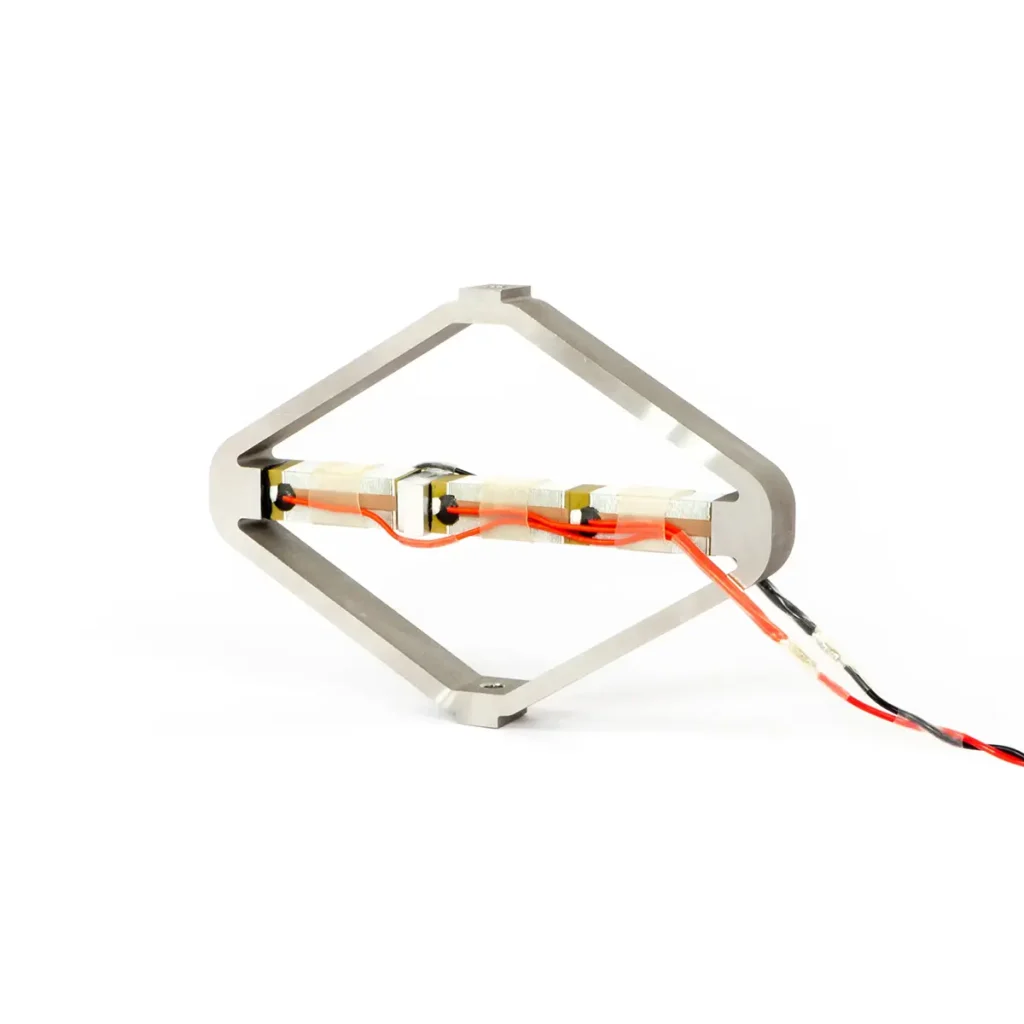
Based on these technologies, Cedrat Technologies’ main products include Fast Steering Mirrors (FSM) and precision tip-tilt mechanisms, Parallel Pre-stressed Actuators and Amplified Piezo Actuators (APA®), XY stages and optical scanning systems, Fast Piezo Shutters and piezo motors, as well as magnetic actuators, electro-magnets and sensors.
For control electronics, the company also offers OEM Amplifiers, PLa Linear Piezo Amplifiers and integrated control electronics, including the Compact Controller Board CCBu20-NS for New Space applications.
These products are available as Commercially off-the-Shelf (COTS) standard products or as solutions adapted to specific application requirements. Their integration enables functions including optical pointing, line-of-sight stabilization, micro-scanning, image resolution enhancement, high-precision positioning and vibration control.
Embedded Optronic Systems
In embedded optronic systems, Cedrat Technologies has 25 years of experience supplying pointing and positioning mechanisms and has delivered several thousand units, including Dynamic Tip Tilt (DTT) mechanisms, Fast Steering Mirrors (FSM) and XY stages, together with their associated CCB control electronics.
These products benefit directly from Cedrat Technologies’ space heritage, combining high performance, resistance to vibrations, shocks and thermal constraints, low power consumption, and integration within limited space and mass budgets. For customers, this technological maturity helps reduce technical risks, simplify integration and ensure consistent performance in series production.
Building on this experience, the company applies the industrial expertise gained through these deliveries to manufacturing solutions for New Space and for applications involving series-produced instrumentation, balancing performance, reliability, cost and production rate.
Space and New Space
Space is one of the fields in which Cedrat Technologies has long conducted research and development. The company has been developing space mechanisms for more than thirty years. Its piezoelectric and magnetic actuation technologies are used for pointing, nano-positioning, optical scanning, stabilization and optical communication.
To drive and control these mechanisms, the company developed the Compact Controller Board CCBu20-NS for New Space and Low Earth Orbit (LEO) missions. This all-in-one controller integrates two piezo push-pull channels, digital PID control with stabilization filters, and strain gauge conditioning on a single board.
With dimensions of 150 × 100 × 50 mm, a mass of 0.8 kg and typical power consumption of 5 to 28 W, it helps optimize SWaP and simplify the integration of FSMs, DTT mechanisms and XY stages. To accommodate different mission durations, the board is offered in three manufacturing levels for LEO missions lasting more than one, three or five years, respectively. It is designed to meet the vibration, shock and radiation requirements of space applications.
In terms of application scope, Cedrat Technologies’ solutions can equip satellites in Low Earth Orbit (LEO), Medium Earth Orbit (MEO) and Geostationary Orbit (GEO), and can also be used in deep-space exploration missions. They address the needs of various systems, including Optical Ground Stations (OGS), satellite-based Optical Communication Terminals (OCT), Quantum Key Distribution (QKD) systems, Earth observation instruments and optical payloads.
For the New Space market, Cedrat Technologies continues to expand its series production capabilities and adapt its solutions to requirements for quality, reliability, cost and production rate. SWaP optimization helps preserve integration margins on satellite platforms while maintaining pointing and stabilization performance.
Space Heritage
These technologies have been implemented in space projects. Cedrat Technologies’ know-how has contributed to several scientific missions, including ROSETTA, PHARAO, EarthCARE, Meteosat Third Generation (MTG), PSYCHE and IASI-NG. These missions have all been successful and have demonstrated the performance and reliability of the company’s products and systems.
The associated developments include DTT or FSM pointing mechanisms, XY stages, micro-scanning and stabilization systems, and mechanisms for deep-space optical communication.
Research, Development and Intellectual Property
To address product and application requirements, Cedrat Technologies’ research and development activities cover precision mechatronic mechanisms, piezoelectric and magnetic actuation, smart materials, sensors, control electronics and control algorithms. These activities include the development of standard products, prototypes, pre-series and series products, and custom solutions.
Among these, technologies developed in-house include Dynamic Tip Tilt (DTT) mechanisms, Piezo Fast Steering Mirrors (P-FSM) and XY stages, all based on APA® technology, as well as Magnetic Fast Steering Mirrors (M-FSM). APA® uses a patented Amplified Piezo Actuator architecture. Development work focuses on increasing usable stroke, improving dynamics and reliability, and enhancing integration capabilities within limited space.
History
1977: Establishment of the Cedrat Recherche research centre.
1989: Launch of engineering activities.
1995: Grant of the first patent relating to piezo actuator technology.
1998: Cedrat Recherche delivers its first flight model to the European Space Agency (ESA): an APA®-based XYZ piezo mechanism for the ROSETTA mission.
2001: Adoption of the name Cedrat Technologies.
2002: Development of the DTT35XS piezo optical pointing mechanism for the CNES PHARAO programme.
2006: Delivery to THALES of XY piezo mechanisms for infrared cameras.
2012: Spin-off from the Cedrat group and joining ASF.
2013: Relocation to new premises and formalization of the 3C® values.
2022: Extension of the cleanroom to meet demand from the space and optronics markets.
2023: Expansion of the assembly, integration and testing area.
2025: Establishment of Cedrat Technologies (Shanghai) Co., Ltd. in Shanghai.
With the establishment of its Shanghai subsidiary, the group set up a local service team in China. Cedrat Technologies’ Shanghai team provides local support to Chinese customers, covering requirements identification, product selection, coordination of custom development and technical support. It also gives customers access to the group’s engineering, industrialization and testing expertise.
Corporate Values, Quality and Recognition
In terms of corporate culture, Cedrat Technologies builds its culture around its 3C® values: Concert, Collaboration and Cordiality. These principles guide relationships within teams and with customers and partners throughout the process, from requirements definition to industrialization and support for the solutions.
In terms of quality management, quality is an integral part of Cedrat Technologies’ strategy. Cedrat Technologies is ISO 9001 certified for its engineering, development, prototyping, pre-series and series manufacturing activities, and associated services. This certification formalizes the management system established to ensure process control, traceability and the continuous improvement of products and services.